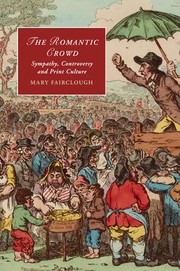
Romantic Crowd
earliest edition we have, 2013 University of Cambridge ESOL Examinations, 2015 312 pages
"In the long eighteenth century, sympathy was understood not just as an emotional bond, but also as a physiological force, through which disruption in one part of the body produces instantaneous disruption in another. Building on this theory, Romantic writers explored sympathy as a disruptive social phenomenon, which functioned to spread disorder between individuals and even across nations like a 'contagion'. It thus...
Where to get it
Search WorldCat (worldwide union catalog) for this title
This opens a library search. We don't know what any library holds — the search may come back empty.
Change library
How it reads
Your log
What readers call it
No reader has tagged this one yet — be the first.
Sign in to confirm or add — reader tags are the only source of this information.
Content warnings
Reported by readers, not by us or the author. Unreported is not the same as absent.
No content warnings reported. That means no reader has added one yet — not that this book has none.
Also called trigger warnings. Reader reporting opens with the reading log.
Editions we hold
Bibliographic facts on this page come from the Open Library monthly dump (CC0) unless a correction says otherwise. Nothing here is generated.